Dear Community,
a solid foundation for the patient transport system in SimDispatcher has already been established. However, as I regularly operate ambulances (KTW) in my district, I would have quite a few new features that would make the system even more realistic. I have compiled a list of these that I would like to put online in this bundled form:
- KTW Plan / Route Overview
Especially in dispatch centers where several hundred patient transports must be handled daily, ambulances are sent to the next call as soon as they report S1. To optimize this process, many dispatch centers have the ability to arrange calls in a staff overview, “pre-assigning” them to vehicles and thus “assembling” individual trips into a kind of route.
The dispatch system calculates the call duration from S7-S8 time and expected treatment and handover time. This allows the dispatcher to schedule the trips and also consider and plan break corridors.
One implementation option is shown here by rescuetrack:
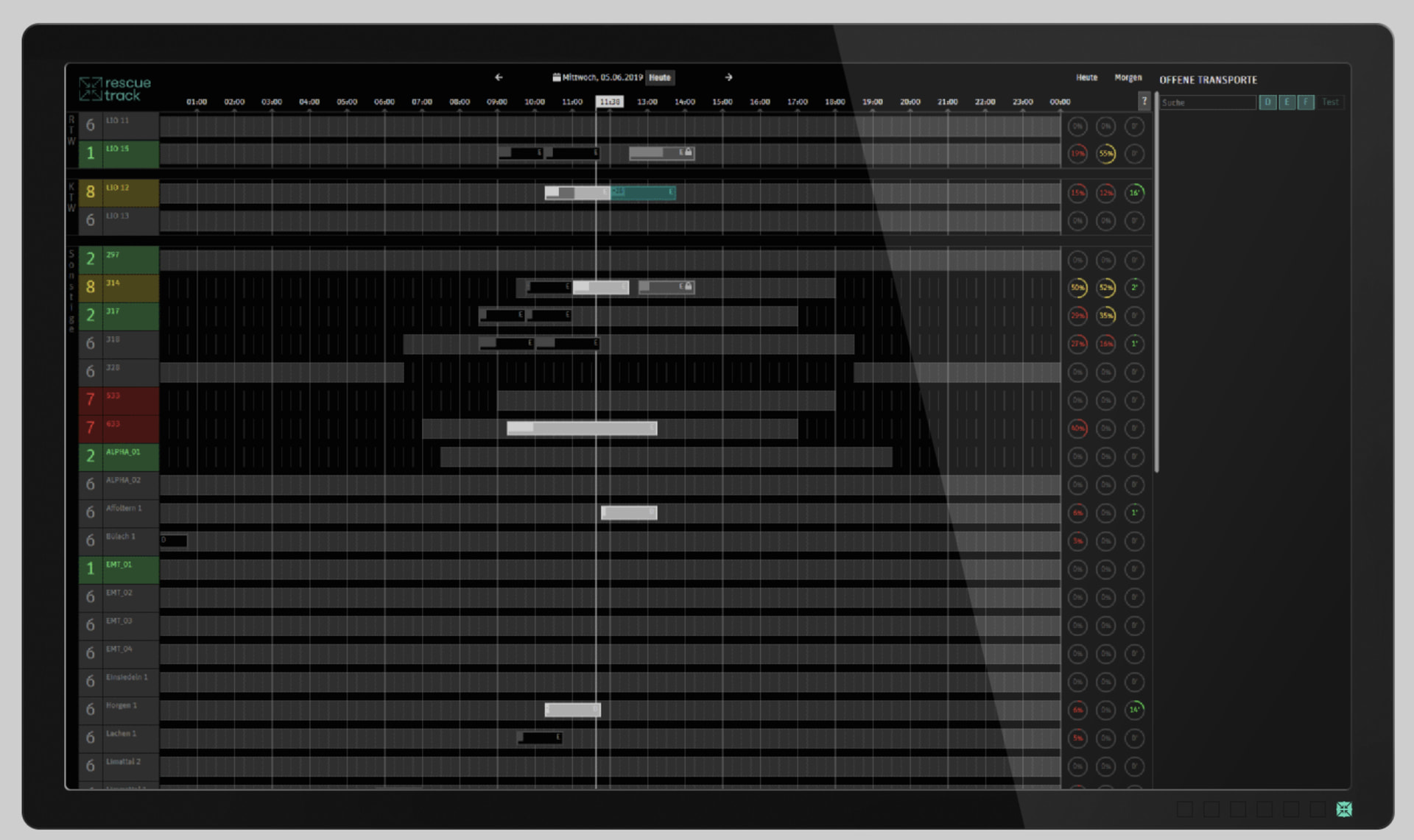
( Image source: rescuetrack | Krankentransport )
- KTW Remain at Scene in S1 After S8
To improve the system from point 1, there could also be a toggle on-off option in the admin area that can be set so that ambulances wait on scene for a while when they switch from S8 to S1, giving the dispatcher time to send the new call without possibly driving in the wrong direction and thus extending the response time.
- KTWs Provide Duty Times at Start of Shift
Since duty times or vehicle identifications can change from day to day (relief organizations rotate vehicles to distribute kilometers evenly), it is common in some districts for ambulances to verbally report their duty time via a communication request at the start of their shift, so that the dispatcher can also enter this if necessary. Of course, this can also be set as a toggle on-off option in the admin area.
- Break System
Currently, it is already possible to send KTWs / RTWs into a kind of “break” via the “is for standby” option for a keyword. However, you must keep track of ending the call after 30 / 45 / 60 minutes yourself or (if the KTWs in my district do this by putting themselves in S4 with a break call) set the vehicle to S2. With its own function like “is for break”, vehicles could automatically put themselves back into S2 after the set break time and thus relieve the dispatcher of this work (or represent it realistically, as the crew walks to the vehicle and sets S2 in reality).
- Outbound and Return Trip in One
For small treatment runs such as X-ray checks, blood draws, or catheter changes, it is common for ambulances to also perform the direct return trip of the patient if a certain wait time (10-20 minutes) is not exceeded. This gives the relief organization another transport bill and the dispatch center does not have to tie up a vehicle for this later. For this, the ambulance crews usually request the return trip from the emergency dispatch via a communication request or by phone. For SimDispatcher, this would also be a feature that would realistically represent day-to-day operations.
- Infectious Disease Transports
One of the most demanding and time-intensive calls for patient transport are infectious disease transports by far. Currently, these are implemented in SimDispatcher neither for patient transport nor for emergency rescue. Since this is particularly part of the day-to-day business for patient transport, such a feature would be very desirable. There could also be a new question in the emergency call intake for patient transport that explicitly asks about special circumstances such as infections. If a vehicle takes on such a call, it would be realistic for it to have a longer S4 time, as the necessary protective equipment must be put on. After S8, the vehicles would then either stand in S8 longer depending on the infection and clean on scene, or request a disinfection order and drive to the station. In this case, vehicles would also not be available for operations during the exposure time.
- Special KTW Calls
Since I have never noticed such a KTW call during my playtime so far, I would have a series of new scenarios that are typically handled by ambulances. These include:
- Blood and organ transports,
- Transport of medical supplies (e.g., medications, infusions, laboratory samples, antidotes, empty incubators, etc.),
- Transport of medical personnel (e.g., pediatric emergency teams that can be requested by other hospitals),
- Helicopter landing site transfer from the air rescue and HEMS-TC.
- Checking In and Out of the District
This proposal is applicable to both patient transport and emergency rescue. As is normally customary in every district, rescue vehicles check out from the dispatch center when leaving their own radio and traffic area, or check in with the dispatch center upon re-entry. During this time, vehicles are also standardly not reachable by radio.
- Reason for Admission
Standardly, information about the reason for admission is provided during general practitioner referrals to the dispatch center (poor general condition, pain, worsening of an underlying condition, etc.), which is incorporated into the call notes so that the ambulance crew can already prepare for the procedure during the response.
- KTW False Calls
Every now and then, due to planning chaos, miscommunication, etc., a patient transport does not take place. The following scenarios can be incorporated into SimDispatcher as examples:
- The patient has already been transported away.
- The transport was accidentally ordered too early or for the wrong date.
- In the meantime, the patient’s condition has deteriorated so much that they are no longer transportable.
- The transport was independently canceled by the hospital during the response.
So, that would be the end of the compilation of suggestions. I hope that some or even all features can be implemented in one way or another over time. If any more ideas come up for me or you, please feel free to add them. I will expand the list accordingly.
Best regards 
[Addition from 22.10.2026]
- Vehicle Failure
Like every other industry, emergency medical services struggle with staff shortages, sick leave, and understaffing. To further adjust the fun or stress factor (depending on play preference  ), stations could report to the dispatch center at the start of each shift and deregister a vehicle or the respective shift for today due to one of the reasons listed above. The probabilities and a maximum number of failures per day could be set in the admin area.
- Vehicle Defects
Emergency medical services and fire department vehicles are exposed to extreme stress. The classic ambulance motto is not without reason: “If the engine is cold, give it six and a half.” Therefore, as with vehicle failure, there is a certain probability that vehicles in service may suffer engine damage, cause collision damage, or require inspection. These failures could also be incorporated into the SIM analogously to point 11.